Table of Contents
At 400 square feet or less, United Tiny Homes offer an affordable path for ownership.
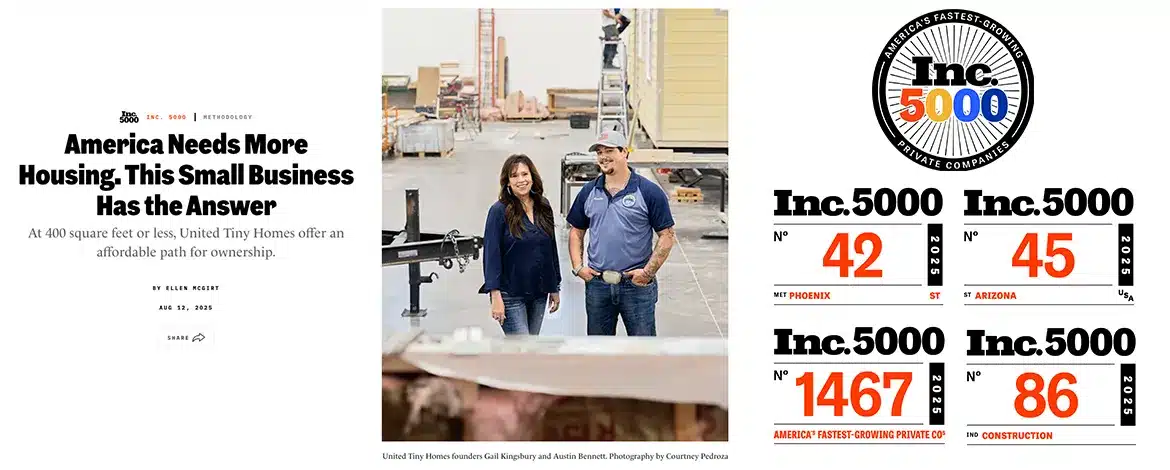
Early in 2020, Gail Kingsbury was just one inspiration away from her next big idea. “I had decided to be a snowbird and see what that was like,” she recalls of the time when the pandemic sidelined her global events business. She relocated from Oregon to an RV park in Glendale, Arizona, where she spent time outdoors with her daughter, Jenna Hall, and family friend Austin Bennett, a former professional soccer player- turned-builder.
The pair had been recruited to join a tiny-home-building outfit started by a friend of a friend, and Kingsbury, 62, was curious about the industry. The founder, she realized, was wildly unqualified. “So we couldn’t work with him,” she says with the calm possessed by the truly unflappable. But the trio had become invested in the idea of high-quality, affordable homes designed for a specific type of homebuyer.
“We’d done the research. Jenna learned the business, Austin could build, and I put together a marketing plan,” says Kingsbury. “So we just started our own company.”
Without a construction facility, Kingsbury found a builder in Southern California who used their specs to create two home models, which they showcased at the Maricopa County Home Show in 2021. “I know how to do events,” she says. “We had people standing in line for over two hours in nearly 100- degree weather to walk through those homes.” Seventeen deposits later, Kingsbury was in business. “That weekend bootstrapped us to where we are now.”
Today Kingsbury is co-founder and CEO of United Tiny Homes, which has a mission to design and build high-quality, affordable homes that are 400 square feet or less. Kingsbury calls these starter homes: solid, livable dwellings with quality finishes included in the base price of $80,000 to $140,000—quartz countertops, soft-close cabinets, Pergo laminate flooring, and full-size appliances.
The homes are ideal for young families, single homebuyers, retirees, in-law or rental units on existing properties, or even entire planned communities. They don’t have to be relegated to mobile home parks. And so far, the few resales they’ve seen have held their value. United Tiny Homes grossed $2.4 million last year and expects to quadruple that in 2025. “We’re projecting about $25 million next year,” Kingsbury says. “We’re on to something here.”
Kingsbury says the four-year-old company has found a very specific niche. While tiny homes have long been associated with whimsical, artistic, or off-the-grid lifestyles, municipalities facing persistent housing shortages are embracing a new designation— accessory dwelling units, or ADUs—that opens the door to broader adoption. In 2024, for example, Arizona passed House Bill 2720, legislation that allowed municipalities to permit ADUs in single-family residential zones.
Kingsbury’s first phase of growth was funded by about $1 million from friends and family. Now, she’s in her first-ever funding round, looking to raise a Series A for a total of $10 million, which is aimed at expanding her factory.
Each home is semi-custom built. A $100,000 United Tiny Homes house generally costs $65,000 to construct. Buyers with a 25-year mortgage typically need only a 5 percent down payment—$5,000. “I don’t get paid until the home is delivered and connected to utilities,” she says. “So, I need gap funding for the materials and labor.”
United Tiny Homes delivers code-compliant homes, meaning they’re built to local standards. Kingsbury says that’s rare in the largely unregulated world of tiny- home-building. As a result, serious buyers—including several municipalities in Arizona, which Kingsbury says are purchasing 155 ADUs—need reliable partners that can navigate the thicket of regulatory issues.
“People think tiny homes are a fad,” she says. “But they’re actually a solution.” That credibility has also turned Kingsbury into an advocate, helping elected officials and major employers understand what ADUs are and what they can do for their communities.
The company currently employs 26 people, most of them in the factory. Kingsbury hints at slowing down someday (“Maybe if I get some grandbabies”), but right now, her focus is squarely on growth.
And she wants everyone to come along for the ride. A tour of the immaculate facility reveals two loyal shop dogs—a Doberman named Titan and a husky named Zeus—and another unexpected touch: Builders are encouraged to create vision boards that reflect their dreams and aspirations. Kingsbury is deeply committed to the personal development of her builders, a cohort that often includes workers whose first language is not English.
On the walls of the break area, a bigger picture takes shape through words and images of trucks, healthy meals, family, mindfulness, entrepreneurship, and raises. “We’re planning to build beautiful communities around the country,” she says. “We’re also building one right here.”